

By Chinedu Nwagbara
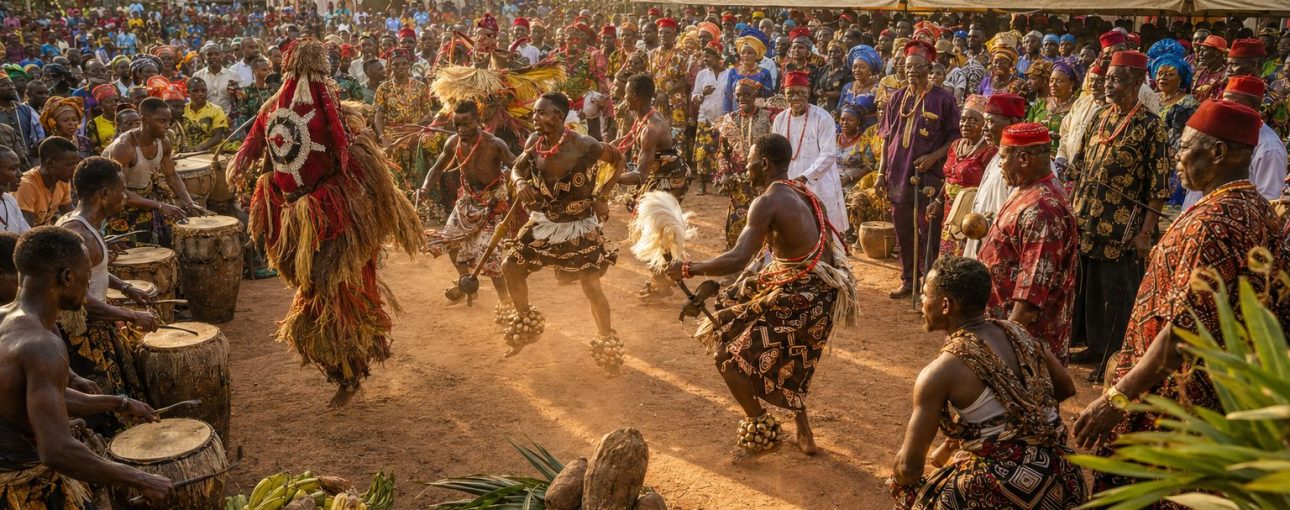
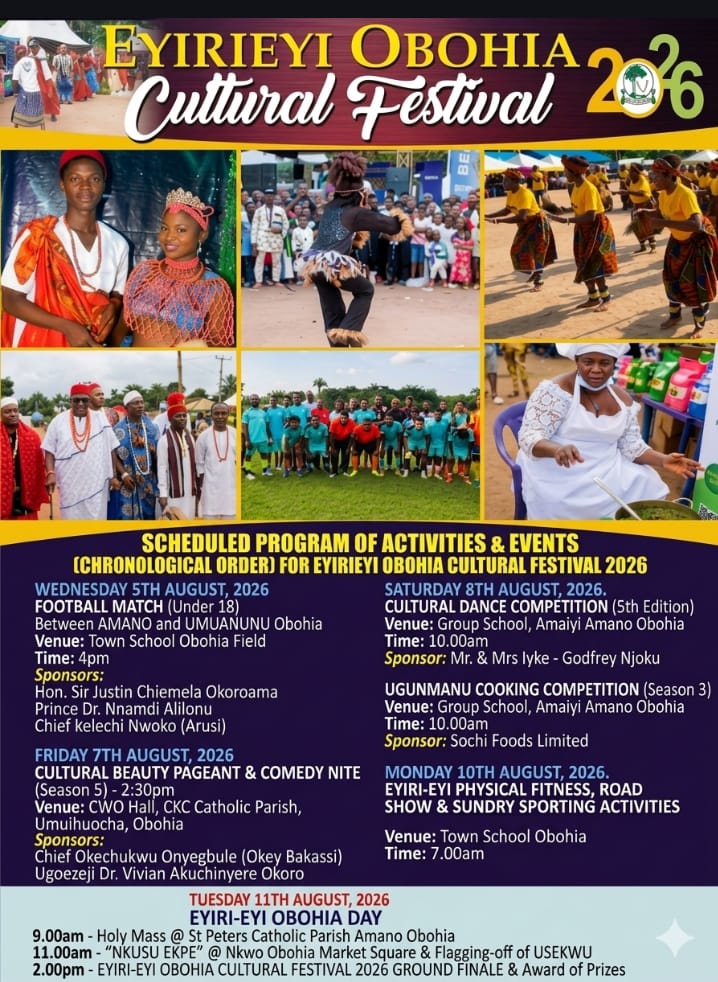
Eyire Eyi Obohia stands today as one of the most enduring cultural heritages of the people—celebrated for unity, peace (udo), reconciliation, and collective identity. As we approach the 11th of August 2026, it is important that this celebration is not only embraced in festivity, but also understood in its true historical, cultural, and institutional context.
From preserved oral tradition and sustained community practice, the origin of Eyire Eyi is traced to the ancestral figure Ezeala, whose lineage is rooted in the Anaekwe (Umunwachukwu) kindred of Ihitte Obohia. Ezeala is not merely symbolic; he is recognised within tradition as a foundational progenitor whose authority shaped the early social, spiritual, and cultural order of the people.
Within this structure, Ezeala held the supreme traditional authority represented through Ofor—the enduring symbol of truth, justice, and legitimacy. This authority was not abstract; it was institutional, guiding communal decisions and preserving order.
Central to this origin is his first son, Nnaka, associated with Umunnaka in Ihitte, who holds a distinct but complementary authority through Ntumere—the responsibility to announce and activate the Eyire Eyi season.
It is recounted that Ezeala, accompanied by Nnaka, once journeyed on a visit, during which they were received and offered kola (oji). This kola, by its form and cultural significance, was regarded as sacred. They returned with it to Ihitte Obohia, where Ezeala entrusted it to Nnaka to plant at Umunnaka as a lasting symbol of covenant, remembrance, and unity.
This act marked the origin of what is now known as Oji Eyire Eyi.
From that moment, a structured ritual system emerged—one that continues to define the festival.
Whenever the kola matures and falls, it must be identified and picked by a bona fide member of the community, not a stranger. The lineage of Nnaka then exercises its authority of Ntumere to announce the season, while the lineage of Ezeala (Anaekwe/Umunwachukwu) exercises the authority of Ofor to validate and give final legitimacy to the process.
Following this, the kola proceeds, in agreement with related lineages, to their brothers in Elekeowasi—specifically the Duruji (Umuduruji) lineage—where it is ritually broken.
This process is not incidental. It reflects brotherhood, continuity, and shared ancestry, as Duruji (Umuduruji) are historically of the same stock, having migrated from the original Ihitte base.
Over time, this practice became a binding customary covenant among the founding lineages, forming the basis of Eyire Eyi—not as a modern arrangement, but as an ancestral system rooted in ritual order and mutual obligation.
This structure has not disappeared. It has been sustained in living memory and practice.
It is well established within community tradition that the Late Eze Obolobo of blessed memory, in observance of this structure, consistently commenced the Eyire Eyi process through Ihitte, beginning with consultation at the Ezeala lineage, before proceeding to Umunnaka for the Ntumere process.
This sequence reflects both customary obligation and institutional respect, confirming the continued relevance of the foundational structure.
Within contemporary recognition, the custodianship of the Ezeala lineage remains identifiable, and individuals within that lineage have been widely acknowledged by traditional authorities, including reigning Eze figures and respected elders, as representatives of that ancestral authority within living tradition.
THE SPIRIT OF EYIRE EYI
Beyond its ritual structure, Eyire Eyi represents a complete system of life as practised by the forebears.
It was a period defined by peace, reconciliation, and moral order. There were no written agreements, yet society was governed by truth, trust, and honour. Transactions were binding by word; land pledged for debt was redeemed without dispute. Integrity was law.
Eyire Eyi was therefore a season of restoration, where disputes were settled, wrongs corrected, and relationships renewed. Participation required a clear conscience, as the season itself embodied justice and communal balance.
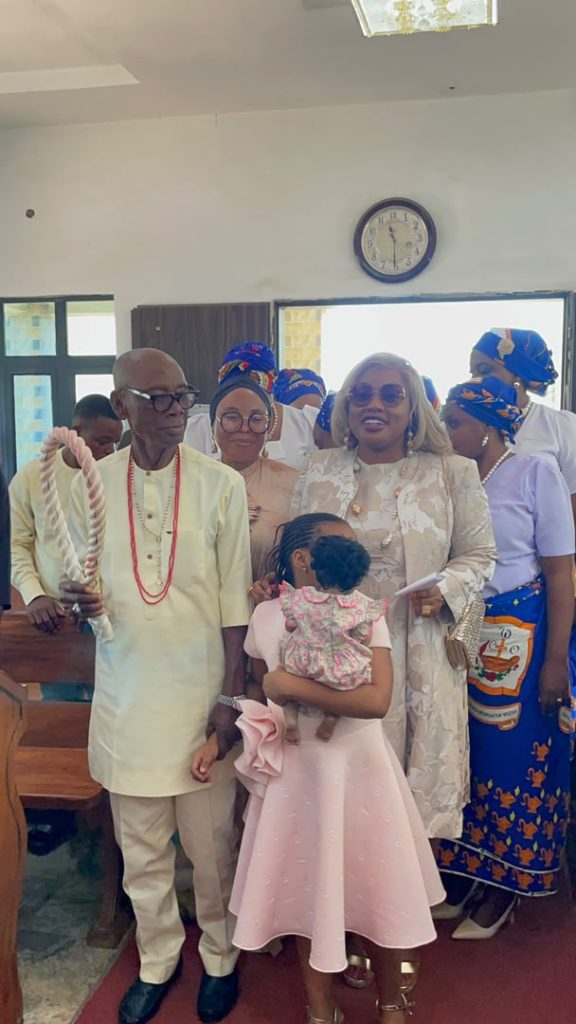
Before the advent of Christianity, Ezeala was revered within the traditional system as a central authority of order and spiritual reference. With the coming of Christianity—particularly through figures such as Monsignor Okoro—these practices evolved, incorporating religious observance while preserving their essential meaning.
The intellectual and historical documentation of Eyire Eyi has also benefited from the work of scholars such as Sir Alban Acholonu, whose contributions helped bring wider awareness to the cultural significance of the festival, even as living custodians of tradition continue to preserve its depth.
EXPANSION AND CONTINUITY
Historically, the expansion of Obohia followed this ancestral structure:
Nnaka lineage extending into Duruji (Umuduruji – Elekeowasi)
Other branches settling in Umulo Elekeowasi
Extensions giving rise to Umudim (Amaiyi)
Amaiyi further connecting to Umuedo (Umuowasi)
Elekeowasi linking to Umuamara Nno (Umuhoocha)
Communities such as Umungara, who later came as visitors, were accommodated within the land. While fully part of the broader Obohia community, their role in Eyire Eyi remains historically distinct.
A CALL TO UNDERSTANDING
It is therefore important to emphasise that Ihitte—particularly Umunnaka—remains the starting point of the Eyire Eyi ritual process, not as a matter of preference, but as a matter of origin, authority, and established custom.
As the elders say:
“Onye amaghi ebe mmiri bidoro ma ya, agaghị ama ebe ọ ga-asọ kwụsị.”
Eyire Eyi is not just a festival.
It is a covenant, a memory, and a living heritage.
As we celebrate, may we do so in unity, truth, and full understanding of who we are.
Udo Eyire Eyi diri anyi nile